
"A good drummer listens as much as he plays." ~ Indian Proverb
Percussion Store Drummers Drum Lessons Drumming FAQs
International Shipping
"A good drummer listens as much as he plays." ~ Indian Proverb
Percussion Store Drummers Drum Lessons Drumming FAQs
International Shipping



Drums & Percussion
Drum Sets & Cymbals
Cymbals, Hardware & Accessories
Latin Percussion
LP Hardware, Accessories & Replacement Parts
Middle-East Drums & Percussion
African Drums & Accessories
Chinese & Eastern Drums & Percussion
Irish Drums & Percussion
Orchestra Bells & Chimes
Drum & Percussion Hardware

El Bongosero, in my opinion, has three
functions in the traditional Latin salsa band. First, he helps solidify
the groove of the rhythm section by adding the alto-soprano range of the
hand drums, like the conga, which adds the tenor-bass range of the rhythm
section. Second, he provides the improvisational responses to the
vocalizing of the sonero, Iike the quinto player in the folkloric rumba
groups. Third, he plays the bongo hand-held cowbell which reinforces the
bell pattern played by the timbalero, thus creating the infectious drive
which gives the Latin music its magical feeling.
In order to play the
bongos, you must develop the technique necessary for the
execution of the main bongo pattern called the "martillo or hammer". It is
essential that this pattern be learned well, since most variations are
derived from the martillo pattern.
I also suggest that you listen to as
many of the great players of this instrument as possible, such as
Armando Peraza,
Jose Mangual Sr., Roberto Roena, Rolito Soto and others.
To get you started, the first step is to
learn to hold the bongo in its traditional form. Note that this technique
is for right handed players. If you are left-handed, just reverse the
instructions.
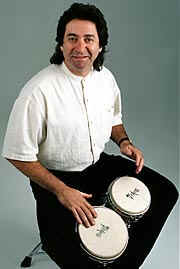
Make sure you have a seat that is not too
high. Position yourself at the edge of the seat comfortably with your legs at an
approximate 90 degree angle. Place the macho (male-small drum) above your left
knee. Now place the hembra (female or large drum) below your right knee and hold
firmly. Once you are in this position you are ready to begin.
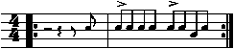
The bongo uses mostly the fingers and
thumb in contrast with the conga, which uses more of the full hand. So the
pattern that you are about to learn will have the following key:
M= martillo tip of index finger right hand
Tmb = thumb left hand
F= fingers left hand
T= tap right index finger
O= open
Note that the pattern begins on 1, and
the thumb is left resting on the head. In this way the tip of the index
finger (right hand) can strike on the edge of the drum creating the sound
called martillo. The rest of the motions follow accordingly.
Practice these patterns slowly
concentrating on the hand movements and sounds. As the accuracy becomes
more consistent increase your speed.
Find some music to play along with. I
suggest that you start with the bolero (ballad) pattern and moving up to
faster patterns gradually. I perform on the LP video,
Adventures in Rhythm Volume 2: Close-up on Bongos and Timbales,
where this technique is explained in more detail.
Bongos for Sale

Bongo Lessons - Essays & Articles by the Pros