
"A good drummer listens as much as he plays." ~ Indian Proverb
Percussion Store Drummers Drum Lessons Drumming FAQs
International Shipping
"A good drummer listens as much as he plays." ~ Indian Proverb
Percussion Store Drummers Drum Lessons Drumming FAQs
International Shipping



Drums & Percussion
Drum Sets & Cymbals
Cymbals, Hardware & Accessories
Latin Percussion
LP Hardware, Accessories & Replacement Parts
Middle-East Drums & Percussion
African Drums & Accessories
Chinese & Eastern Drums & Percussion
Irish Drums & Percussion
Orchestra Bells & Chimes
Drum & Percussion Hardware

By
Kurt Rasmussen with Special Thanks to His Brazilian Instructors,
Carlines De Our Pandiero, Padre Miguel, Marcello Marigini, Tobias de Vai-Vai,
Adieu de Vai- Vai, Mark Lamson, Marcos Suzano, Carlinhos Brown, Dr. Michael
Carney, Nené Repinique and Alessandro D' Agostini Miranda
|
 |
|
|
The word Caixa (pronounced ka-sha) simply means box in Portuguese. In musical terms the Caixa is a Brazilian snare drum which may have originally been a Portuguese military snare drum and is made of lightweight Aluminum. The Caixa is used in the Bateria of an Escola de Samba (The percussion section of a samba school) for playing Samba Enredo (Carnaval Samba).
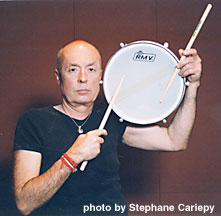
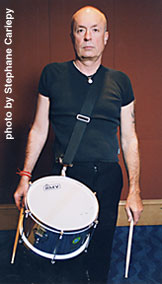
In the past the Caixa was held on the shoulder (photo 1). Today it is typically slung over the shoulder with a strap (photo 2) and played with a pair of drumsticks.
The
Malacacheta
is a type of Caixa usually 8” X 12”. The Caixa I’m playing is a Malacacheta and
is the Caixa usually used in the Bateria. The
Tarol
and
Repique
are other types of Caixas and are usually 4” X 12” or 14” and
usually has a natural head and is often played in more folkloric styles of
Brazilian music.
The Sticking
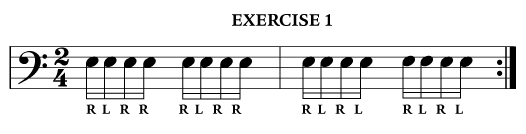
In Section 1 of the video will show you the sticking. The sticks can be held
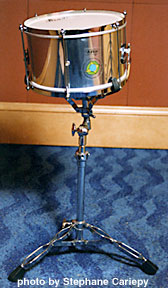
either with traditional or matched grip. I prefer matched grip (photo 3). The
Caixa is traditionally played with the snare on the top. The ride used for this
article is one of the most basic patterns. This ride is mounted in 3/2. Check
out the Repinique article for more information on what this means. I’m also
exaggerating the movement of my hands and the sticks but you’ll want to refine
the technique as you learn. There are other rides used by the different escolas
(schools) but the feel will be similar. Most of the work is done with the right
hand, while the left hand gives rhythmic support. If you are just learning to
play Brazilian percussion, I suggest practicing slowly at the beginning till you
get used to the sticking pattern. Practice this until you are really comfortable
with it.
The Rim shot
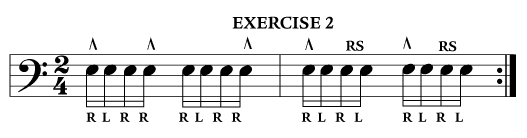
In Section 2 of the video I’m going to add the rim shot. The rim shot is done
with the right hand. A rim shot is done by striking the drum rim and drum head
at the same time. Start slowly and gradually increase the tempo till you’re
really comfortable with both the sticking and the rim shot. This ride and other
Caixa rides also can contain little ruffs and rolls incorporated into the
pattern but in this article I prefer to concentrate on the sticking and the
feel.
Click for Kurt's Online Video Lesson by Stephane Cariepy go to:
http://www.lpmusic.com/Play_Like_A_Pro/Tips/kurt2.html
Don’t Mean a Thing if it Ain’t Got that Swing
Brazilian’s refer to the feel or the swing as swingui (pronounced swinggee). The
swingui is felt by all the percussion instruments in the Bateria. I suggest that
you listen to any recordings of Carnaval you can find. You may find the
listening suggestions in the Repinique article helpful.
|
|
|
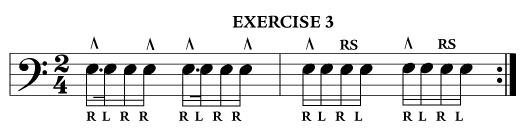
In Section 3 of the video I’ve added the swingui. I’m playing it exaggerated so
hopefully you’ll find it a little easier to feel it. You’ll have an easier time
if you already know the sticking and rim shots. In Section 4 of the video I’ve
added Alessandro D’Agostini Miranda on Surdo so you can get an idea of what the
ride will sound like when it’s played in context. We’re playing this at a fairly
slow tempo You’ll want to work up to playing this at approximately 150 bpm which
is about the tempo that is played at during Carnaval. Lastly, I suggest that you
enlist the help of a teacher knowledgeable in Brazilian percussion techniques to
help you further your studies. This article only scratches the surface and my
goal is that it inspires you to further your knowledge. Click to hear the RMV
Caixa. This Caixa example has a slightly different ride. You also might want to
listen to all the other RMV instruments that I recorded.
Attention All Drummers!
Drum set players… yes, I’m talking to you! Even if you are not interested in
playing traditional Brazilian music, please do yourself a favor and checkout a
RMV Caixa. They sound great in many forms of music. For one of the funkiest
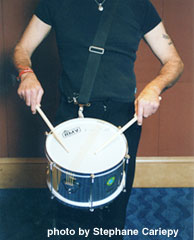
sounds around, just turn the drum snare side down (please see photo 4) like a
traditional snare drum. You can also use an RMV Caixa as a second snare drum.
Add one to your collection, you won’t be sorry!
Sou Branco y Preto
Kurt Rasmussen
(Kurtinho do Pandiero)
Kurt Rasmussen has been a baptized member of the Brazilian Escola de Samba
Vai-Vai since 1997. He has participated in four Carnavals, and is a four time
Carnaval Champion. He has toured and performed with many notable Brazilian
artists, such as Moacir Santos, Sergio Mendes, Tania Maria, Kleber Jorge and
L.A. Samba led by good friend and fellow LP artist, Ron Powell . Kurt is also
teaching at UNLV and is Director of the University’s Escola de Samba Mocidade
Rebelde. Kurt is also currently playing percussion with Cirque du Soleil in
their production of "O" in Las Vegas .
To download this lesson in PDF format, please CLICK HERE.
|
PLEASE NOTE:
|
Caixas for Sale
Drum Lessons
Hand Drumming & Ethnic Percussion
