"A good drummer listens as much as he plays." ~ Indian Proverb
Drums & Percussion Drum Heads & Skins Parts & Accessories Gongs & Sound Healing
"A good drummer listens as much as he plays." ~ Indian Proverb
Drums & Percussion Drum Heads & Skins Parts & Accessories Gongs & Sound Healing





Latin Percussion
LP Hardware, Accessories & Replacement Parts
African Drums & Accessories
Steel Tongue Drums
Gongs & Tam Tams
Cymbals
Cymbals, Hardware & Accessories
Middle-East Drums & Percussion
Doumbeks, Darbukas & Accessories
Indian Drums & Percussion
Irish Drums & Percussion
Japanese Drums & Skins
White Steer Skins for Taiko Drums
Orchestra Bells & Chimes
Drum & Percussion Hardware
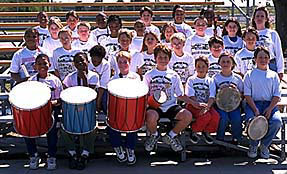
Dr. Howard Pitler - L'Ouverture Computer Technology Magnet.
1996-97 Kansas Elementary Principal of the Year.
1997-98 National Distinguished Principal from Kansas.
Teaching 4th and 5th grade children the percussion instruments and rhythms used
in the samba schools of Rio de Janeiro has been a learning experience not only
for the children, but for the instructor as well. I began teaching grade school
children samba batucada in the spring of 1995. Dr. J.C. Combs, professor of
percussion at Wichita State University, organized fifty 4th and 5th grade
children to perform at the University Percussion Ensemble concert for that
spring. The following fall I instructed 4th graders at Collegiate Lower School
in Wichita, who were featured on the "Samba for Kids" video with Dr. Combs and
San Francisco Bay Area percussionist
Michael Spiro. For two months during the spring of 1996 I met with 4th and
5th grades at Buckner Magnet School in Wichita, and in April of that year they
performed at the MENC (Music Educators National Conference) in Kansas City, as
well as in the Percussion Ensemble concert a few days later.
During my first meeting with a group of elementary students, I give them a brief
history of the music of samba. I begin with a geography lesson- "Can anyone tell
me where Brazil is?", followed by a history lesson- ("who colonized Brazil?, How
and why did Africans come to Brazil?, etc.). We then talk about Rio De Janeiro
and its poor neighborhoods, the favelas. I describe as much as I can about the
living conditions, and why the samba schools (or groups) in these neighborhoods
help to bring the community together. An Escola de Samba, or samba group,
includes 2,000 or more people (sometimes as many as 7,000), all working towards
the goal of winning carnival - to have the best theme, song, dancers, floats,
and bateria, or percussion group. The bateria is the driving force of the samba
school, propelling the group down the parade route, playing the style of samba,
known as batucada. The escola uses a myriad of percussion instruments, but in my
teaching at the grade school level, I show them the ganza,
tamborim,
ago-go,
cuica,
pandeiro
and surdo. The first instrument I introduce to them is the ganza, or
shaker. While I'm playing it for them, I ask them what the rhythm reminds
them of: "a snake!"...no! "a washing machine!"...getting closer "a
train!"...YES!!!. The rhythm should make one want to move, and playing a ganza
is much harder than it appears. I then demonstrate the proper technique: Imagine
a line in front of your nose, move the ganza equidistantly above and below the
line.
The result of doing this correctly creates what I call a locomotive rhythm.
Initially when the students begin playing the ganza they have the tendency to
use their whole arm instead of just the wrist. Some will almost throw their arm
out of the socket! It takes a while for them to get the right touch and feel,
but I've learned not to worry about this at first. I just keep reminding them
why their arm hurts after two minutes of playing. Once the ganza players get the
motion and the rhythm correctly, they tend to move more to the beat than the
other sections. The next section that I teach includes the tamborim. This small
frame drum is played with a small stick, or a few plastic dolwel sticks taped
together at one end. The basic rhythm that I teach the students is phrased in a
2/3 "clave" rather than the 3/2 "clave" (or phrasing) that is more frequently
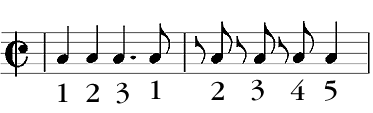
played in Brazil. The rhythm looks like this:

Starting the pattern in this way makes it easier for the kids to "lock in" to the rhythm because it starts on the downbeat. Sherri Pilgreen, the music teacher with whom I worked at Collegiate, came up with a method of counting the
tamborim part to help the students verbalize the rhythm.
The ago-go, with two differently pitched bells that are attached, provides a melody to the whole batucada. The rhythm that I teach to the students is a basic pattern and looks like this:
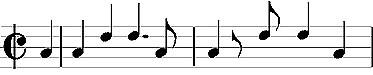
Students have a tendency to either play this pattern too fast when the tempo is
slow, or to play behind the beat when the tempo is brighter. I tell those in the
ago-go section to make sure that the second note on the low bell is locked with
the high surdo. The patterns for the
tamborim
and ago-go bells may appear to be the most difficult of the samba rhythms. This
is not necessarily so, especially since the most important rhythm is that of the
surdo. The surdos are the bass drums in samba batucada, and provide the
foundation for the entire ensemble. The best players should therefore play the
surdo parts, and so I usually have "secret auditions" for those who will play
this instrument. The rhythm for the high surdo is:

and for the low:

and the two together:

I tell the students that if the surdo parts aren't played correctly, the whole
ensemble will fall apart. If there are enough players, I add a third surdo that
plays:

This is phrased along with the 2/3 "clave" of the tamborim and ago-go parts. The
ganza,
tamborim,
ago-go, and surdos
are the sections on which I concentrate. The pandeiro is played using a
thumb-heel-tip motion with one hand but this is somewhat difficult to do, so I
just have the students shake the pandeiro like a ganza. As for the cuica, I tell
students to work on getting the low and high sounds, without breaking the
stick!!
I meet with the students once a week and for the first couple of visits, Ihave
them switch instruments so that all may have a hand at each rhythm. Eventually,
the student stays with the instrument he or she seems most comfortable with.
I play a drum known as the repinique, which I use to teach the kids a rhythmic "call" that tells the ensemble when to begin and when to stop. With the aid of a samba whistle and hand cues, I indicate to the students whether I want to feature a certain section and have the other sections drop out. We also work on call and response rhythms. I play a rhythm and they play it back. Some of the calls that I use I borrowed from the C.D. "Brasileiro" by Sergio Mendes. Other calls can also be made up by the instructor or by the students themselves. The calls can be played at the beginning of a piece and to close a performance.
I tell the students that the goal is to make music with these percussion
instruments, not simply to make a bunch of noise. By the third week, the rhythms
start to come together. The most important thing to me is seeing those kids who
initially had no interest in music now come alive as they beat a surdo or an
ago-go rhythm. Just one smiling face makes it all worth it.
Janet currently teaches Brazilian and Afro-Cuban drumming at Wichita State University in Wichita, Kansas.
"Our 4th graders love the Samba Band program. We received our drums in February, and were able to dazzle an audience by April. Parents told us it was the best thing they had ever seen their children do. Not only did my kids learn a great deal about music, they learned about how kids their own age lived in Brazil and Africa. The cultural diversity component of the program makes it a "must have" for students in a global society."
